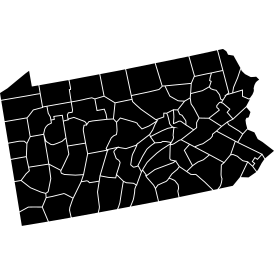
Pennsylvania Property Records
Property records in the Commonwealth of Pennsylvania are public registers maintained at the county level, typically by the recorder of deeds. These property instruments document who owns what land or building and when ownership changes hands.
Preserved land records support a range of functions: tracking ownership, monitoring title transfers, assessing real estate taxes, and researching a property's legal history. They give you a window into how the property has been used and encumbered over time.
Pennsylvania's 67 counties maintain their own registries and collectively document more than 5.86 million housing units statewide. Whether you are a homeowner, investor, or researcher, understanding the structure and uses of these public property documents will enable you to navigate the system more confidently.
Introduction to Property Records
Pennsylvania's land documentation dates back to the 17th century, when William Penn established the colonial Land Office in 1682. Some of the earliest surviving papers include land grants, warrants, and surveys from that era, which formed the foundation of the state's property record system.
Today, Pennsylvania operates under a deed recording system, which means you rely on recorded instruments such as deeds, mortgages, and easements filed within the county recorder of deeds office. There is no statewide title registry.
Many counties have digitized indices, searchable imaging, and parcel viewers. The Commonwealth also supports geospatial access through Pennsylvania Spatial Data Access (PASDA), which you can use to overlay parcel maps and public Geographic Information System (GIS) layers.
These recorded real property files also power taxation, assessment, and planning: assessors and taxing authorities rely on deed and parcel data for valuations and millage calculations. Meanwhile, planners, surveyors, and environmental agencies use the same sources for land-use, development, and regulatory work.
What Counts as Property Records in Pennsylvania
The state has various public documents that record ownership, transactions, financing, and land use.
Deeds & Title Records
Deeds and title papers serve as the legal evidence of who owns a property and how ownership changes hands. While Pennsylvania doesn't publish a statewide total, county reports show tens of thousands of deeds recorded each year. In Somerset County alone, roughly 12,000 new property documents are filed annually.
Ownership History & Transfers
Ownership and transfer records trace the transaction sequence that defines a property's chain of title. These filings show each sale, inheritance, or conveyance that confirms clear ownership.
Mortgage & Loan Documents
Mortgage and loan instruments show financial obligations connected to real property, including mortgages, notes, releases, and satisfactions. You can locate these documents in the same county offices that manage deeds. Mortgage filings are indexed to notify the public of liens or lender interests, and releases show when a loan has been repaid.
Property Tax Records & Assessments
Property tax and assessment records reflect how each parcel is valued for taxation. County assessors maintain these databases, which are used to calculate tax bills that fund schools, public safety, and local infrastructure. Pennsylvania's average effective property tax rates differ widely among counties.
Property Values & Market Data
Property value and market data records summarize trends in real estate prices, including median sale prices, appreciation, and regional differences. Based on the available data, the median home value in Pennsylvania is about $282,000. Values in metropolitan and suburban areas typically exceed the state average, while rural regions trend lower.
Building Permits & Zoning Records
Building permits and zoning files document approvals for new construction, renovations, and land-use changes. Municipalities participating in the state's Uniform Construction Code submit quarterly permit activity reports to the Department of Community and Economic Development.
Liens, Foreclosures & Judgments
Reviewing lien and foreclosure data gives you a clearer view of a property's legal and financial standing. These records list any claims placed against a property.
Parcel Maps & Land Surveys
Parcel maps and land surveys define boundary lines, lot numbers, easements, and rights-of-way. These maps are essential for identifying parcel sizes and ownership boundaries.
Pennsylvania Property Law
Pennsylvania property law lays out the rules for who owns what, how property changes hands, and what you can do with your land within the state.
Key Statutory Framework
Pennsylvania property law is primarily codified in several key statutes:
The Pennsylvania Consolidated Statutes (Pa CSA) Title 20 (Decedents, Estates and Fiduciaries) addresses property inheritance and estates.
Title 68 (Real and Personal Property) covers fundamental property rights, transfers, and landlord-tenant relationships.
The Pennsylvania Municipalities Planning Code (Act 247) establishes zoning and land use regulations.
The Uniform Condominium Act and various recording statutes require proper documentation and protection of property interests throughout the commonwealth.
Deeds and Property Transfers
Property transfers in Pennsylvania require proper documentation and recording to be valid.
When someone dies without a will, state law decides who inherits their property. These rules are found in 20 Pa CSA Chapter 21 (Intestate Succession). They outline how real estate and other assets are divided among relatives in an orderly way, even if the deceased person didn't leave specific instructions.
While the real estate is titled directly to the heirs and beneficiaries, it remains subject to the personal representative's powers as stated under 20 Pa CSA § 301. The representative handles the overall estate, paying debts, managing assets, and distributing what remains to the rightful parties.
Mortgages and Deed of Trust
Real estate loans in the state are secured through mortgages, not deeds of trust. If you borrow money to buy a home, the lender holds a lien on the property until the loan is fully repaid.
State laws include several protections for homeowners:
Mortgage Satisfaction Act: To prevent problems like "clouded titles," the law requires lenders to provide official proof and a satisfaction piece to record that the mortgage has been paid off within a set period.
41 Pennsylvania Statutes (PS) § 403: Lenders must follow clear steps before taking back a property. Under this statute, they must provide the homeowner with a mandatory notice of intent to foreclose that provides proper time and opportunity to resolve payment issues before any foreclosure can proceed.
42 Pa CSA § 8103: This act requires the lender to petition the court to determine the property's fair market value after a foreclosure sale if the price paid at the sale was less than the debt owed. The borrower is then discharged from liability for the fair market value amount, protecting them from a potential deficiency judgment that is too high.
Easements and Land Use Rights
Easements grant specific rights to use another person's property for designated purposes, like utilities or access.
42 Pa CSA § 5530 sets the period for acquiring property rights through adverse possession, which is generally 21 years of actual, continuous, exclusive, visible, notorious, distinct, and hostile possession. However, for a single-family dwelling on a lot of half an acre or less, the period is 10 years (under 42 Pa CSA § 5527.1).
Meanwhile, the Pennsylvania Municipalities Planning Code contains provisions for easements, rights-of-way, and dedications related to public infrastructure, utilities, and access rights that affect private property as part of local planning and development.
Zoning Regulations
Zoning laws control how property can be used within specific areas, separating residential, commercial, and industrial zones.
53 PS § 10601 through § 10619 establish procedures for zoning ordinances, including how municipalities create and enforce rules about building heights, lot sizes, and permitted uses in different zones.
53 P.S. § 10901 through § 10914.1 provides property owners the right to appeal zoning decisions through zoning hearing boards for a fair process when disputes arise over land use restrictions.
Public Records Law
Pennsylvania's general public access law is the Right-to-Know Law (RTKL), which governs access to records held by state and local government agencies. It establishes a strong presumption that all government records are public unless a specific exemption applies.
The following laws also mandate that legal documents affecting real estate ownership be available to the public in county offices:
21 PS § 351 et seq.: Deeds, mortgages, and other property documents must be recorded in county offices. Failure to record can render a conveyance void against a subsequent bona fide purchaser or mortgagee.
16 P.S. § 7629 (and Related Local Acts/Sections): This establishes the fees and procedures the recorder of deeds office can charge for recording property documents.
The Role of Government Agencies
County offices are your first stop for most property files. Each county typically maintains a recorder of deeds (or equivalent office) that reviews, records, indexes, and provides public access to deeds, mortgages, liens, and related instruments.
State bodies preserve older records at the Commonwealth level and provide data and mapping support. The Pennsylvania State Archives and the historical commissions keep colonial and other long-term land papers, while Pennsylvania's official Geographic Information System (GIS) clearinghouse aggregates parcel and mapping layers that you can use for spatial research.
For estate-related transfers, you'll also interact with the courts (the Orphans' Court division of the Court of Common Pleas handles probate and estate administration), which affect how title passes after death.
County registries must be distinguished from municipal offices. The former hold the land records and assessment rolls, while municipalities usually handle building permits, code enforcement, local zoning, and some permit records. County assessment and tax offices then use recorded ownership and deed data to keep tax rolls current and calculate local assessments.
How to Access Property Records
You can access property and land records in Pennsylvania through several methods, depending on the county and the type of document you need.
Online: Most Pennsylvania counties now offer searchable databases for recorded deeds, mortgages, and related documents. For example, Cumberland County provides records access through Landex, which keeps deeds in the county from as early as 1750.
In Person: You can visit your county's recorder of deeds or a similar office to view or request copies of property documents.
By Mail: Many counties accept mail requests for certified or regular copies of property records. You typically need to submit a request form and include the required fee.
By Phone: If you're unsure where to start, you can contact your county recorder of deeds office for guidance on requesting specific documents.
Limitations of Accessing Property Records
Searching for recorded land documents in Pennsylvania can be complicated because there is no single central office or website. Depending on your needs, you might have to consult different portals or contact multiple offices to find property information in different parts of the state.
The costs and formats for obtaining documents also vary significantly by county. Some offices may allow you to view scanned images for free online, but you will be charged a fee for a certified or high-resolution copy. Other counties may require you to purchase a subscription or pay per-page fees just to download files.
Finding the exact instrument you need can be slow because the searchability and completeness of records are uneven. Indexes can be inconsistent, sometimes requiring you to search by a person's name (grantor/grantee) and other times by a parcel number. Furthermore, scanned document images are often not searchable by computer text.
Complexity is added by historical gaps, lost or damaged records, and transfers handled through court processes.
You'll also have to contend with privacy and technical restrictions. Personal identifiers like Social Security Numbers are typically redacted from public copies, and certain court or sealed records may be unavailable without a specific legal order. Because of these factors, it is best to budget extra time for your search and confirm your findings with a qualified title professional.
How Property Records Are Updated
Any change, encumbrance, or other action affecting real property in Pennsylvania requires county offices and state agencies to update public records to reflect the property's current legal and tax status. Below are the common triggers and how often those records typically get updated:
After a Sale or Transfer of Ownership: Upon recording a deed or conveyance, the county recorder or register scans, files, and indexes the document for the current public record. Many counties, including Bucks County, make newly recorded instruments available online within 24-48 business hours, though verification and final indexing can take longer.
When a Mortgage, Lien, or Release Is Filed: Mortgages and liens are added to the public record as soon as the document is accepted. If a state tax lien is satisfied, the Department of Revenue begins the lien-satisfaction process about 45 days after the payoff is confirmed.
When Building Permits Are Issued: Local building departments issue permits immediately upon approval. These are then reported to the state as required under Pennsylvania's Uniform Construction Code.
When Assessors Update Valuations for Tax Purposes: County assessors maintain property value records for tax purposes. The State Tax Equalization Board compiles and reviews data annually and certifies assessed values and market ratios by July 1 each year.
When Court Judgments, Foreclosures, or Sheriff Sales Occur: When a court judgment, foreclosure, or sheriff sale changes ownership, related filings are added to both court and county land records. These updates occur as the case progresses, with sheriff's deeds recorded once a sale is finalized. Timelines vary by county, and procedures are available through each court of common pleas and the sheriff's office website.
The Importance of Property Records
Property documentation matters because it gives you the legal facts and historical context about land and buildings. Different people rely on these records for different reasons:
Homebuyers: Check property records to confirm ownership, find out if there are liens, and review past sales.
Real Estate Agents: Use them to understand a property's history, price trends, and legal details for listings and sales.
Lenders: Review recorded documents to see if the property can be used as collateral and that there are no hidden claims.
Lawyers and Title Professionals: Study title history to verify ownership and fix any legal issues before a sale.
Developers and Builders: Look at zoning maps, plats, and permits to determine what can be built and where.
Historians, Journalists, And Researchers: Use old deeds and maps to study how communities and ownership patterns have changed.
What Information Do Pennsylvania Property Records Contain
Pulling a property file in Pennsylvania commonly provides you with the following items:
Owner name(s) and mailing address
Legal description (metes and bounds or lot/block description)
Parcel identifier (parcel ID, tax parcel number, or PIN)
Recorded deed type (warranty deed, quitclaim, sheriff's deed) and recording citation (instrument number, book/page or recording ID)
Grantor/grantee index entries and chain-of-title history
Recorded mortgages, notes, satisfactions, and releases
Liens, judgments, tax liens, and UCC filings affecting the property
Easements, rights-of-way, covenants, and deed restrictions
Recorded plats, subdivision maps, and survey drawings
Sale dates and recorded sale prices
Assessed value, tax class, tax parcel roll history, and exemption flags
Building permits, code enforcement actions, and zoning approvals or variances
Foreclosure and sheriff's sale records, if applicable
Document images and scanned copies of the original instruments
Geographic references (parcel map layer, coordinates) and parcel boundary data
Resolving Property Disputes
Property disputes can happen for many reasons, including disagreement over boundaries, unclear ownership, liens, or conflicting claims. The good news is that Pennsylvania provides resources to help you resolve these issues.
Gather official records first. Start by collecting deeds, mortgages, easements, and tax records from your county recorder of deeds or assessor's office.
Verify boundaries with a licensed surveyor. For disputes involving fences, lines, or encroachments, hire a licensed surveyor to produce a survey.
Try to resolve the issue informally. Many disputes can be solved without going to court. Talk to the other party, show your evidence, and consider options like moving a fence, signing a boundary agreement, or granting a permanent easement.
Use mediation or settlement programs. If direct discussion doesn't work, the state has mediation services to help resolve property disagreements faster and less expensively than a full trial.
Consider administrative solutions. Some disputes involve taxes or local land-use rules. You can appeal property valuations through your county board or the Pennsylvania Department of Revenue. Check your municipality or the Department of Community and Economic Development for zoning or permit issues.
Go to court if necessary. If other methods fail, you may need to file a formal lawsuit, such as a “quiet title” action, to confirm who legally owns the property. These cases are handled in your county's court of common pleas.
Disputes involving liens or foreclosure require following court procedures. Check your county sheriff's office or the Pennsylvania Rules of Civil Procedure to understand timelines and options.
Keep copies of deeds, surveys, permits, and correspondence. For complex disputes, it's wise to work with a real estate attorney or title professional to guide you through the process.
FAQs
Yes, most county recorders let you search by grantor/grantee name, but results depend on how names were recorded and whether older records are digitized. If the county index is limited online, you may need to visit the office in person or request a search from staff.
You can request certified copies from the county recorder of deeds. Most offices accept mail, in-person, or online requests and charge a fee, but check the specific county's instructions and forms before you order.
Most recorded property documents are permanent public records. Records are formally scheduled for permanent retention by county governments if they have "continuing administrative and legal value" and are also historically valuable. Core real estate records often fall into this category.
Minor clerical errors generally require a corrective instrument (for example, a corrective deed) recorded in the same county. You may need to file a court action for disputes or legal defects.
Recorded deeds are strong evidence of ownership and are relied upon in transactions and title examinations. However, absolute proof sometimes requires title searches, title insurance, or court resolution.
You can give the county office as much detail as possible: property address, parcel/tax ID, the names of grantor/grantee, and estimated recording date. Providing an instrument/book/page number (if known) speeds up searches.
If you believe your assessment is wrong, you file an appeal with your county assessment appeals board.